
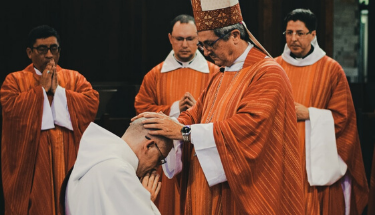
 The sacrament of holy orders in the Catholic Church includes three orders: bishop, priest, and deacon. In the phrase "holy orders", the word "holy" simply means "set apart for some purpose." The word "order" designates an established civil body or corporation with a hierarchy, and ordination means legal incorporation into an order. In context, therefore, a group with a hierarchical structure that is set apart for ministry in the Church. For Catholics, the church views typically that in the last year of seminary training a man will be ordained to the "transitional diaconate." This distinguishes men bound for priesthood from those who have entered the "permanent diaconate" and do not intend to seek ordination as a priest. Deacons, whether transitional or permanent, receive faculties to preach, to perform baptisms, and to witness marriages (either assisting the priest at the Mass, or officiating at a wedding not involving a Mass). They may assist at services where Holy Communion is given, such as the Mass, and they are considered the ordinary dispenser of the Precious Blood (the wine) when Communion is given in both types and a deacon is present, but they may not celebrate the Mass. They may officiate at a funeral service not involving a Mass, including a visitation (wake) or the graveside service at burial. After six months or more as a transitional deacon, a man will be ordained to the priesthood. Priests are able to preach, perform baptisms, witness marriages, hear confessions and give absolutions, anoint the sick, and celebrate the Eucharist or the Mass. Some priests are later chosen to be bishops; bishops may ordain priests, deacons, and bishops.